In May 2024, I was looking through the attendee directory for Manifest (a prediction market conference I was going to next month) to find interesting people who also lived in Toronto, and read about the Toronto AI safety meetup from someone’s blog1. TASM had a pretty big influence on my life, and helped me understand a lot about the field of AI safety.
TASM and Manifest made me realize I was actually pretty interested in AI safety,f and I think it was pretty valuable for me. I started seriously looking into AI safety stuff, and trying to understand what the risks from building transformative AI were. I’m writing this in the hopes it might be helpful for other people to understand how to run good meetups. (well at least meetups I would find good :p)
Later I helped run the meetups a bit. I did a little bit of help with logistics, but most of what I did was helping people get from the lobby to the meetup (since there was building-level security people had to be let through.)
The beginning (for me)
When I first started going the meetups were held in a poorly-ventilated WeWork meeting room. (They were run by a person who also ran a co-working space for AI safety people in Toronto at that WeWork.) The flow was:
- ~30 minutes of socialization and discussion
- Presentation on AI safety news
- Presentation on AI safety topic
- Going to a nearby pub and eating/chatting for a while
Most of the meetup was the presentation on an AI safety topic, and consisted of someone talking about an AI safety topic for 1-2 hours. These events were pretty interactive, with a lot of questions and answers during the presentation. Some examples of the main topics:
- Anthropic’s “Scaling Monosemanticity” paper
- Eliciting Latent Knowledge
- AI Governance Around the World
- Which jobs will AI replace first?
Almost all of the meetups were about a single self-contained thing. There was one multi-part meetup (on AI Control), but that was only because it ended up taking too long to cover in one event. At that point the events were fairly small (~10 people per event) and with a fairly consistent set of people so this was fine, although I don’t think multi-part events would have worked as well once it got bigger.
I really liked this format, and I found it pretty fun and interesting. I liked that it involved a lot of discussing things in a semi-structured way (e.g. questions and answers). There was a whiteboard in the meeting room, which was pretty helpful for discussing things. I wasn’t good at doing unstructured conversations when I started going, and I think TASM helped me with having good conversations.
The more unstructured bits were also pretty good for me, although at first I struggled with navigating my way through unstructured conversations. At my first event I sat down and stared at one of the organizers in silence for 15 seconds (we were both waiting for the other person to start the conversation) before introducing myself. It was useful for finding other people who could help me (e.g. by participating in AI safety hackathons with me), and I also found the other attendees interesting to talk to.
I took a lot of notes about what was discussed during meetups (which are mostly public in my memex). Most of my notes weren’t read again (by me or anybody), but I think note-taking was probably useful for my retention. (They were also useful for writing this post.)
Getting people to come
One problem was getting the word out about the event. Meetup.com was the main place the event was advertised. Meetup has some discoverability features and many attendees said they learned about the event on Meetup. Meetup lets people RSVP to events; usually only about half the people who RSVPed on Meetup actually came.
Scrapping the news portion
Sometimes there were events focused specifically on news, but there weren’t any general news updates before the main thing. I think people felt like the news portion wasn’t super interesting, people cared more about the technical stuff more than AI industry drama. I do think this part was helpful for things like reminding people about things like when MATS applications were open and other interesting opportunities, and although these still got discussed it was unfortunate that there wasn’t a specific place for them to ensure they made it in.
For some time after dropping the news we printed out index-card-sized paper with a description of the news item and a QR code, with the idea that people could look at them and discuss them. There didn’t end up being much conversation around them though, so we dropped that too.
Changing the pub to a cafe
Originally we went to a sports bar that was very close to the WeWork for a less structured and more relaxed conversation after the event. I think that bars in general are generally not good places for meetups. There’s a lot of noise from other customers, background music, and TVs that often makes it so you have to shout at other people. The table layout is fixed and aren’t ideal for splintering conversations or having people move around to talk to other people. Overall, they just don’t have the right vibes.
There weren’t any great alternatives for the pub, but eventually we landed on a fancy cafe that was about a 15 minute walk away. The cafe layout made it much easier to talk and be heard, and it had much better vibes for having free-form discussions. We also started having pizza before the meetups (I think there was some funding obtained for this?), which reduced the need to go to the pub for food.
New venue and lecture-ization
The biggest change to the events was at the start of 2025, when the WeWork lease expired and the AI safety co-working office moved to an Industrious co-working space.
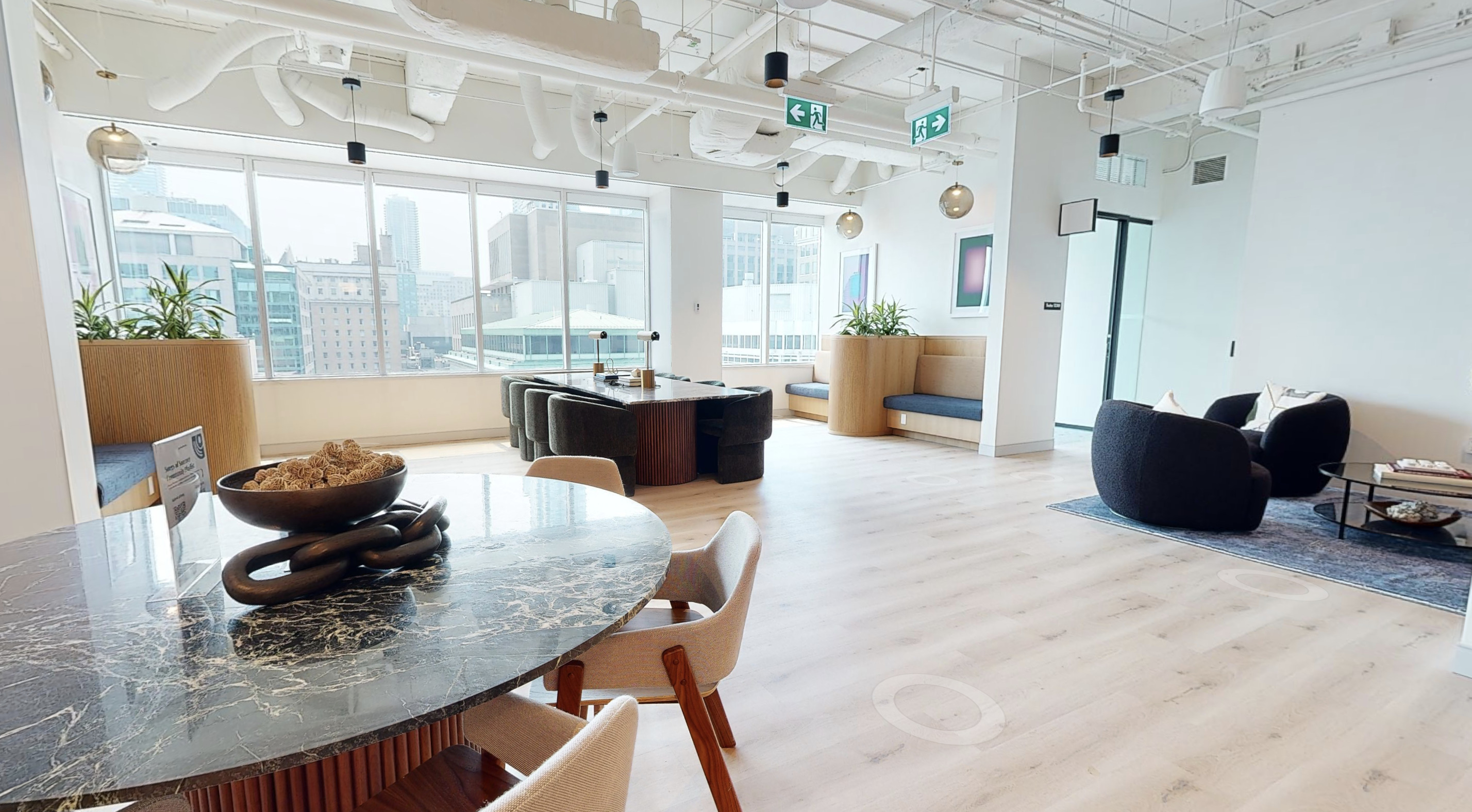 The co-working space area where the events were held; there was a projector and screen that could be set up so the presenter could be to the left of the table by the window.
(Industrious has a nice 3D walkthrough if you want to see more.)
The new venue was:
- Bigger; it had space for a lot more people
- Fancier; it had more decorations and fancy aesthetics
- Pretentious; it had bowls with strange objects to be looked at and books on desks that were there to be looked at instead of read.
- More expensive
The AI safety meetups also went in the same direction, becoming bigger, fancier, more pretentious, and more expensive.
While originally the events were more discussion-oriented meetups with a lot of discussion and question-asking during presentations, the new space seemed to accelerate to change to a less discussion-oriented and more lecture-like event series. When I first started going it was emphasized that the events were discussion-oriented and you should ask questions; later we were told to hold our questions to the end. It felt to me like it shifted from a meetup to a lecture. TASM rebranded to “AI Safety Thursdays”, dropping the “meetup” from the name.
We ended up dropping the cafe with the new venue, because it had more space and was a decent place to socialize in by itself. This makes sense: it’s probably better for attendees to be able to do everything in one spot, and winter temperatures make it more annoying to walk 15 minutes, but I felt like it contributed to the meetups feeling less discussiony.
I don’t think having an AI safety lecture series with an associated professionalish social event before is bad, but it’s not what I prefer and I started going to the events less around this time. I feel like the AI safety community as a whole has become more professionalized as a whole, which I don’t like.
Why did this lecture-ization happen? Some ideas:
- The old venue was a meeting room which put people close together and in a discussion-oriented mindset; the new venue was more focused on having a lot of more spread-out people stare at the presenter.
- There were more people, and the discussion-oriented nature didn’t work as well
- People started asking bad questions
- There were definitely some specific people who asked bad questions, I think this might have contributed to the organizers telling people to hold their questions more. But I don’t think this was a very big issue.
- It became more well-known, and so people started acting more like it was a professional event with high standards
It’s hard to nail down any specific factor, but I feel like the new venue and more people were the main drivers of the lecture-ization.
I feel like the events have largely shifted from being a group of people interested in AI safety discussing it, to being more a more professionalized lecture series. I dislike this; I prefer having honest and deep connections with people over going to professional networking events. I stopped liking the events as much because it had turned into the kind of place where people ask to connect on LinkedIn instead of actually being interested in you.
Charging for events
After being the new venue for several months, we had the opposite problem: we had too many people going to events, with not enough space.
Also at the time, Meetup started becoming a worse platform. So we moved to having public Luma events instead (after a transition period of using both). I think the people who found us on Luma were higher-quality?
I’m not really sure why we had too many people, even after moving to Luma. Probably there are more people interested in AI safety now, and more people had heard of us?
One problem was that there were still too many people. What ended up happening was we instituted a $5 admission charge (or free for students). I don’t like charging people money to go; if I had needed to pay $5 to go to my first event I wouldn’t have gone for the first time, which would have been pretty sad. I don’t feel like the $5 fee is selecting for the right people.
I guess maybe one reason it seemed like a good idea was because of the lecture-ization. Charging people for a ~casual hangout would be strange, but charging people to watch a lecture and have some food is more normal. The nature of the event gradually changed from a hangout to a networking event and I didn’t really notice as it happened.
Aside: attendee instability
One big problem with running an AI safety community in Toronto is that people interested in AI safety usually don’t want to stay in Toronto. SF/Berkeley (and to a lesser extent London) are better places to do AI safety stuff and have a better rationalism community generally, and most people in Toronto who are seriously interested in AI safety would prefer to be living elsewhere. The people who live in Toronto who are interested in AI safety fall into three categories:
- People who really like Canada (or dislike the US), and wouldn’t want to live anywhere else
- People with strong family/social connections to Toronto
- People who can’t move abroad because of immigration-related issues (e.g. can’t get a visa)
Aside: elevators
One downside of having events in those co-working spaces is that the co-working space is on an upper floor, and to get there you have to have a key card. Originally the event description said to call the organizer so he could come down and let you up but this was annoying friction. Many attendees were weirdly un-agentic about getting up to the event; there were several times where I got to the building lobby, found a group of people trying to get to the event, and learned that nobody had actually called the organizer to try to get up to the event.
With Industrious we mostly scrapped the phone call thing and had someone stay in the lobby to let someone up at the start of the event.
I don’t like having events in co-working spaces. I dislike vibes of needing to be let in to the event; I like events to feel open and accessible to people and let people easily come and go at any time. And the Industrious co-working space had a much more fancy aesthetic, which contributed to making the events feel more like a lecture series than a meetup.
Fin
TASM had a big impact on my life, and I hope this post is helpful to anyone thinking of running AI safety meetups. If I was running meetups (maybe I will in the future!), I would try to orient them more towards semi-structured discussions and try hard to find a venue that matches the vibes I want to have for my event.
-
I had read of it briefly while looking at events in Toronto before this, but I dismissed it for idiosyncratic reasons. Seeing that someone else who seemed kinda interesting was going motivated me to go. ↩︎
